


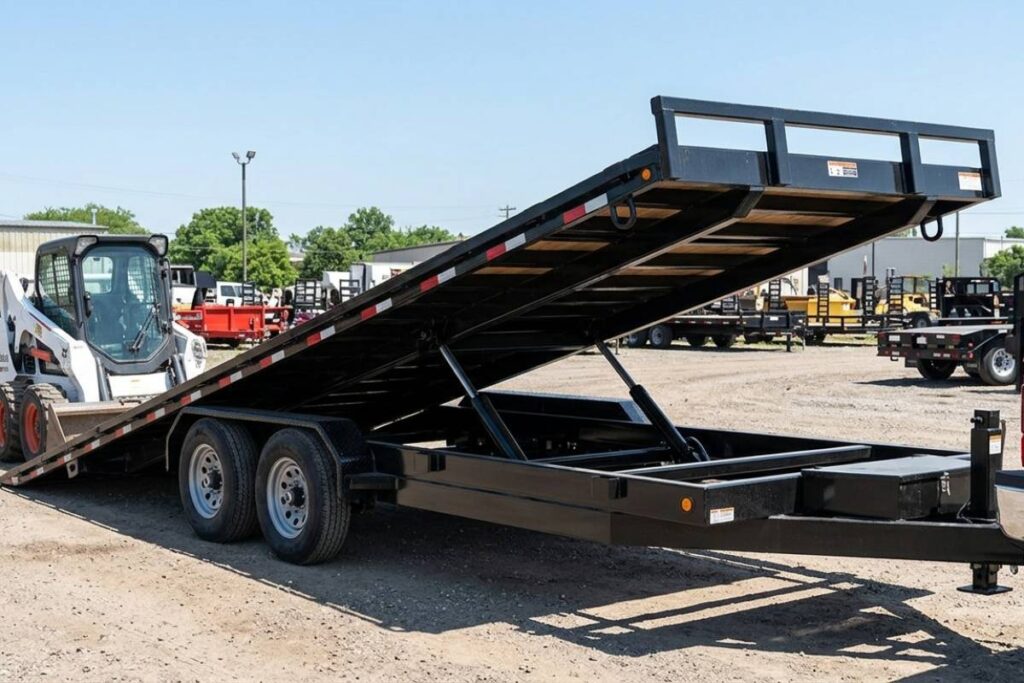
You have heavy gear. Getting it on and off a trailer keeps beating you up, slowing you down, or scratching your equipment. A tilt deck trailer promises to fix all three. But it also costs more upfront, demands more maintenance, and can create towing instability if you load it wrong.
This guide covers every meaningful advantage and disadvantage of a tilt deck trailer, compares it directly to a ramp trailer, and tells you plainly whether it is worth the investment for your specific situation.
What Is a Tilt Deck Trailer?
A tilt deck trailer, also called a tilt bed trailer or tilting utility trailer, is a flatbed-style trailer where the entire deck (or the rear portion) pivots downward at the pivot axle. This creates a low-angle ramp that sits flush with the ground, allowing equipment to roll directly on without needing a separate ramp attachment.
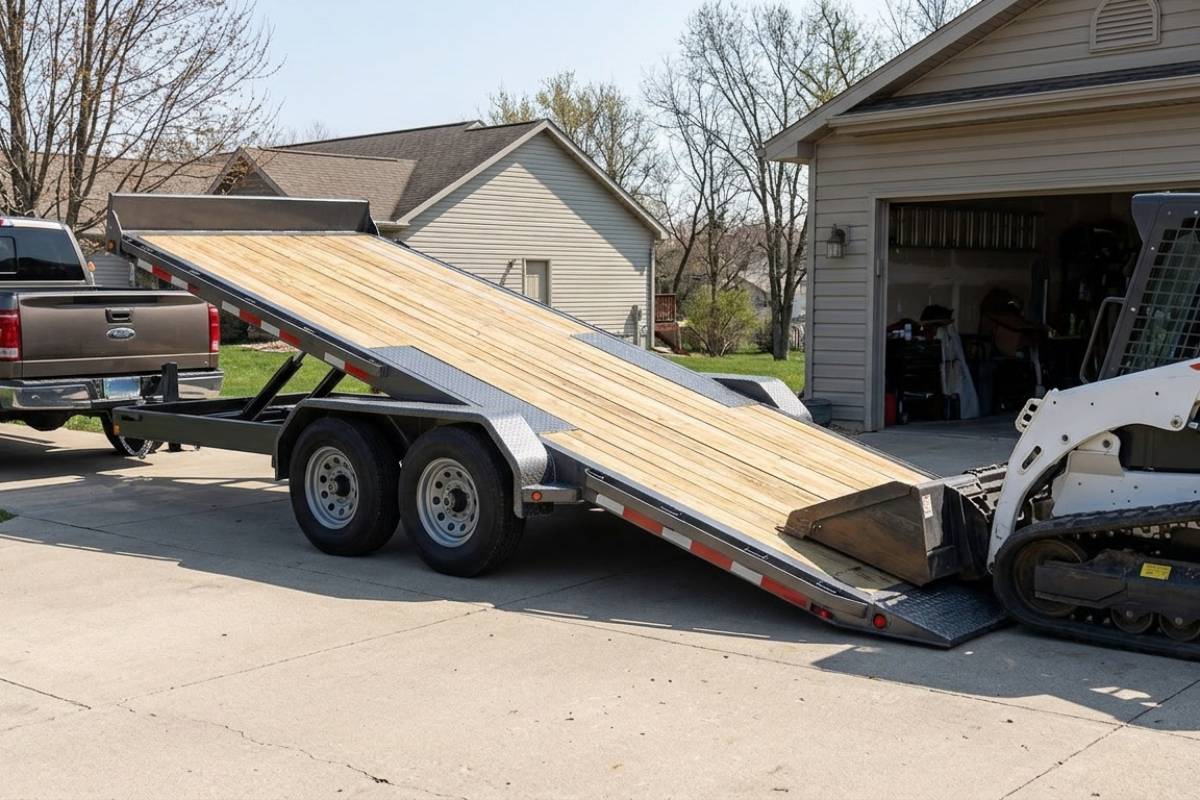

Once the load is on, the deck locks back into a flat transport position. The result is a single unit that functions as both trailer and ramp.
How Tilt Trailers Work: Gravity vs Hydraulic
Not all tilt deck trailers operate the same way. The mechanism matters for your maintenance budget, ease of use, and long-term reliability.
Gravity tilt: The deck pivots on the axle using the weight of the equipment. You release a locking pin, the deck drops under its own weight, and the load drives on. As the equipment moves past the pivot point, the deck levels itself back. No hydraulics, fewer components, simpler maintenance.
Hydraulic tilt: An electric or manual hydraulic cylinder controls the deck movement. The deck raises and lowers on command regardless of load positioning. This gives you more control, especially for partial loads or awkward equipment, but adds a hydraulic system that needs oil, seals, and regular checks.
Which is better? For frequent daily use with heavy, consistent loads, hydraulic gives you more control. For occasional use or smaller equipment, gravity tilt is mechanically simpler and typically more cost-effective long-term.
Pros of a Tilt Deck Trailer
1. No Separate Ramps Required
Ramps have to be stored, transported, positioned correctly, and maintained separately. A tilt deck trailer removes the need for a ramp entirely, saving both the time and effort of setting it up every time you need to load equipment. That convenience compounds fast if you load and unload multiple times per day.
2. Lower Load Angle Protects Low-Clearance Equipment
Standard ramps sit at a steep angle. Low-clearance vehicles, cars with body kits, mini excavators, and scissor lifts frequently bottom out on steep ramp inclines. One of the most important benefits of a gravity tilt trailer is its lower load angle, and the smoother loading transition can also reduce operator stress and make loading feel more controlled.
The low deck angle is especially useful for powered two-wheelers, since transporting a motorcycle across Australia on a steep ramp risks scraping the exhaust or fairing on the ramp edge at entry.
3. Reduced Physical Strain and Injury Risk
For tractor-trailer drivers, overexertion and bodily reaction were the leading causes of nonfatal occupational injury cases, accounting for 35 percent of all cases, according to the U.S. Bureau of Labor Statistics. Tilt loading replaces manual lifting with a controlled roll-on process, directly cutting overexertion risk.
4. Full Deck Space Utilisation
Trailers with foldable ramps permanently sacrifice deck real estate to store those ramps. Tilt trailers allow you to use all the space available on the deck to carry your load, whereas trailers with foldable ramps must spare some deck space to accommodate them.
5. Versatility Across Load Types
A tilt trailer can be used for ATVs, snowmobiles, motorcycles, riding lawnmowers, and tool chests if you can wheel or push it up the ramp, you can use it. Most competing trailer types handle one category well but struggle outside it. Tilt decks handle a wide range without swap-outs.
6. Solo-Operator Loading
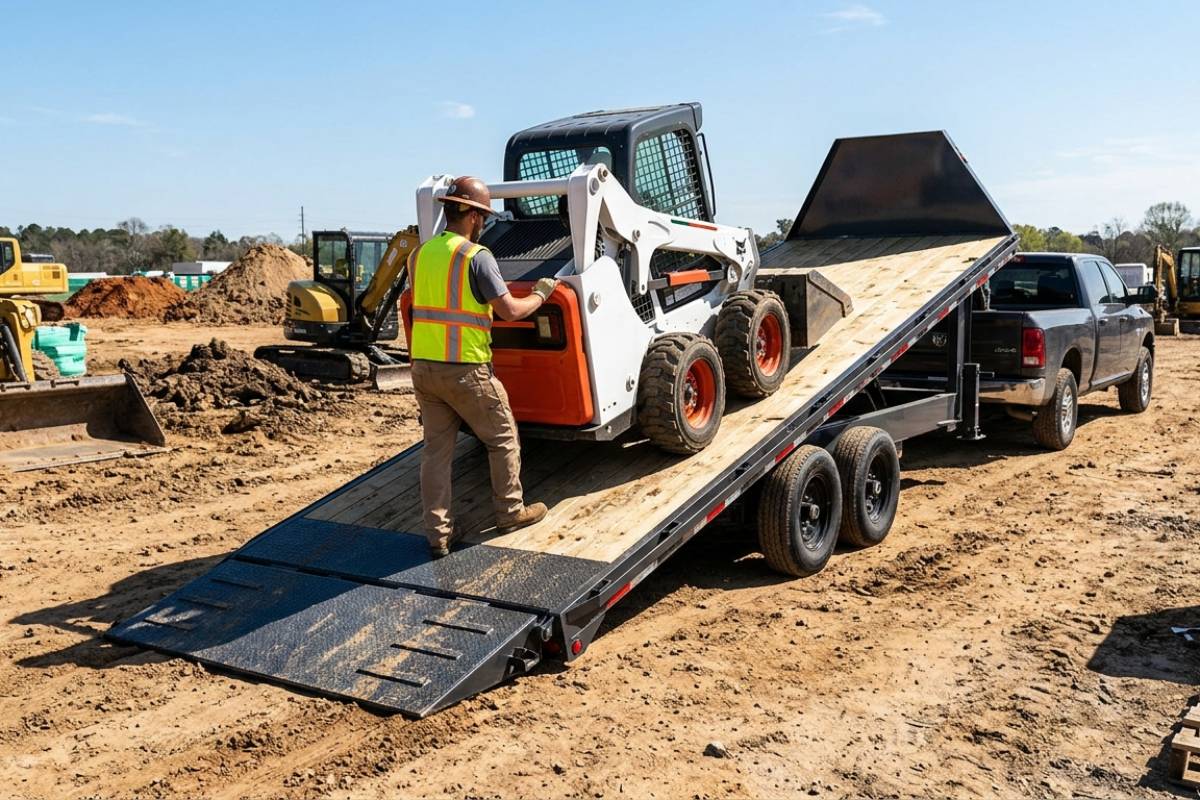
Two people are not required to hold a ramp steady, line up the load, or catch a slide. The deck locks at the ground angle on its own, letting one operator control the entire process safely.
Cons of a Tilt Deck Trailer
1. Higher Purchase Price
Tilt trailers typically have a higher upfront cost due to their complexity and the additional components compared to standard utility trailers. In the Australian market, you are typically paying a significant premium over an equivalent flatbed or ramp trailer at the same capacity rating.
2. Increased Maintenance Demands
Rust on the mechanism that allows for the tilting motion can prevent it from moving at all, negating all a tilt trailer’s benefits, and to prevent this from happening, the mechanism must be oiled properly as part of routine maintenance. Hydraulic systems add oil changes, seal inspections, and cylinder checks on top of that. Neglect the mechanism once, and your tilt trailer becomes an expensive flatbed.
3. Reduced Payload Capacity
The added weight of the tilting mechanism can reduce the overall payload capacity of the trailer, which is a factor to consider for those needing to haul heavy loads. If you are hauling near the maximum rated weight, that mechanical overhead matters.
4. Towing Stability Risks with Poor Weight Distribution
Tilt trailers place the axle closer to the trailer’s midpoint to allow the deck to pivot. This changes the weight distribution significantly compared to a fixed-bed trailer. Overloading the rear or loading too far back shifts the weight off the tow vehicle’s rear wheels, causing trailer sway at highway speeds. A weight distribution hitch and anti-sway control are strongly recommended for heavier loads.
5. Tight Space Needed for Loading
Tilt trailers require only the length of the trailer to load a vehicle, which is ideal for tight spaces. Ramp trailers need an additional 6 to 8 feet behind the trailer to set up the ramps. Wait: this is actually a tilt trailer advantage. The real space constraint works the other way — the tilt action itself requires clear, level ground at the rear. Uneven terrain can prevent the deck from touching the ground squarely, making loading difficult or unsafe.
6. Full Deck Cannot Always Be Used
On a standard tilt where the rear portion tilts, you often cannot place heavy cargo at the very rear of the stationary section because it affects the pivot balance. The usable forward deck space is limited by where the stationary and tilt sections divide.
Tilt Trailer vs Ramp Trailer: Side-by-Side Comparison
| Feature | Tilt Deck Trailer | Ramp Trailer |
| Loading method | Deck tilts to ground | Separate ramps deployed |
| Load angle | Low (gentler incline) | Steeper, depends on ramp length |
| Solo loading | Yes | Possible but harder |
| Low-clearance vehicles | Excellent | Risk of bottoming out |
| Upfront cost | Higher | Lower |
| Maintenance | Higher (mechanism + hydraulics) | Lower (hinges and ramp bolts only) |
| Payload capacity | Slightly reduced | Higher at same GVM rating |
| Deck space | Full usable deck | Partial (ramp storage area lost) |
| Rough terrain loading | Can be difficult | More adaptable |
| Moving multiple pieces | Harder without hydraulic tilt | Easier with separate ramps |
Who Should Buy a Tilt Deck Trailer?
A tilt deck trailer makes clear sense if any of these match your situation:
In Australia’s Northern Territory, operators running remote routes for mine site deliveries, farm machinery hauls, and tilt tray recovery depend on tilt decks precisely because ramp setup on rough or uneven ground is not practical. Darwin Transport is one NT freight specialist built around exactly these demands.
- You load and unload frequently (daily or multiple times weekly), and time loss adds up
- Your equipment is low-clearance and bottoms out on ramp trailers
- You regularly work solo and cannot rely on a second operator to manage ramps
- You haul a varied mix of wheeled equipment, vehicles, and powered gear
- You can manage the extra purchase cost and commit to a basic maintenance schedule
Contractors, landscapers, equipment hire operators, and tradespeople moving skid steers, mini excavators, compact tractors, ATVs, and ride-on mowers are the primary beneficiaries.
Who Should Skip It?
A tilt deck trailer is the wrong choice if:
- You haul maximum-rated loads and need every kilogram of payload capacity available
- Your budget is tight, and you need the cheapest functional option now
- You rarely load heavy equipment (the premium is not justified by occasional use)
- Your usual loading site is uneven, muddy, or on a slope, the tilt deck needs flat, firm ground to work reliably
- You want the absolute lowest-maintenance option. A ramp trailer with few moving parts wins that comparison
Verdict: Is a Tilt Deck Trailer Worth It?
A tilt deck trailer is worth it if loading speed, operator safety, and equipment protection matter more to you than minimising upfront cost and maintenance. For casual or budget-driven buyers, a well-built ramp trailer does the job at lower cost with less upkeep. The premium you pay for a tilt deck only pays back if you are loading regularly enough for the time savings, injury prevention, and reduced cargo damage to add up in real terms.